



Take the rear wheel out and the back of the bike stops being a structure. The chain drops off the cassette and drags across the frame, the derailleur hangs loose on its hanger, and the two seatstays have nothing holding them apart.
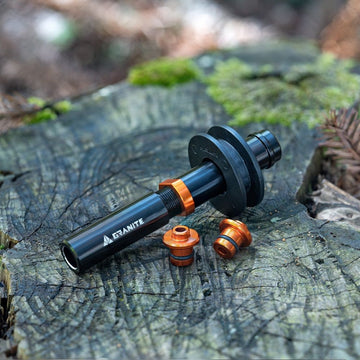
A dummy hub — also called a chain keeper — is the axle-shaped part that goes in when the wheel comes out. It braces the dropouts, holds the chain on a pulley at the right tension, and keeps the derailleur out of harm's way.
What a dummy hub actually protects against
- Compression damage to the rear triangle. This is the one that matters in a bike bag. Luggage stacked on a boxed bike pushes the dropouts together; with nothing spanning them, thin stays and carbon rear ends take the load.
- A loose chain. Unsupported, it swings against the chainstay and the paint, and tangles itself around the derailleur cage.
- The derailleur itself. With the wheel out it sits at the widest, most exposed point of the bike.
- Awkward cleaning. You cannot turn the cranks to run a chain through a brush or lube it evenly if the chain has nowhere to run.

Dummy hub, chain keeper, or an old axle?
The three overlap, and the differences are worth knowing before you buy:
| Braces the dropouts | Holds chain tension | Fits multiple bikes | |
|---|---|---|---|
| Old quick-release axle | Partly | No | Sometimes |
| Chain keeper (chain-only) | No | Yes | Usually |
| Dummy hub (ChainDock) | Yes | Yes — docking pulley | Yes — 130–157 mm, QR and 12 mm thru-axle |
If your only use is cleaning, a chain-only keeper is enough. If you ever box the bike, you want the version that spans the dropouts.
The Granite ChainDock
- Adjustable 130–157 mm, covering most road and MTB rear spacings.
- Works with quick release and 12 mm thru-axle, so one part covers a mixed stable.
- Integrated chain docking wheel — the chain sits on a pulley, so you can spin the cranks to clean and lube.
- 6061 alloy, 120 g.


How to fit a ChainDock
- If your frame has quick-release dropouts, fit the QR adapters first.
- Adjust the ChainDock to the width of your rear dropouts, then hand-tighten the orange lock nut.
- Lay the chain onto the pulley wheel.
- Slide the quick release or 12 mm axle through to hold everything in place.
Hand-tight is the whole specification — there is no torque figure to hit and no tool needed, which matters when you are doing this on an airport floor.

When you will actually reach for it
- Flying or shipping the bike. The case where the frame takes real load and you are not there to see it happen.
- Drivetrain cleaning. Wheel off, chain on the pulley, spin the cranks — the drivetrain is suddenly accessible from every side.
- Car transport with the wheel out. Short trips, but the same loose chain and the same paint.
- Workshops and team support. One part that fits QR and thru-axle bikes across a fleet.
A dummy hub is a small part with a narrow job. The reason it is worth the space in a bike bag is that the damage it prevents — a squeezed rear triangle, a bent hanger, a scratched chainstay — is the kind you find at the other end of the flight, when there is nothing to be done about it.


