

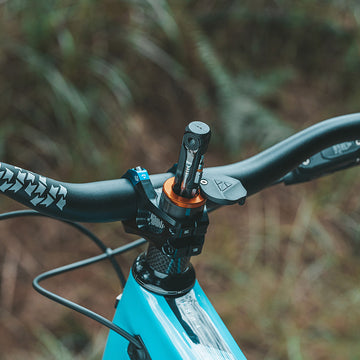
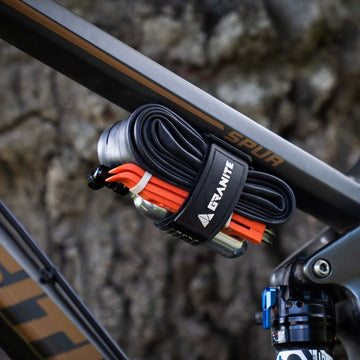

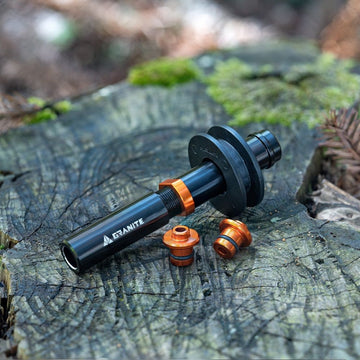

A fork steerer is one of the few genuinely empty spaces on a bike. It is hollow, it is right under your hands, and on most bikes it holds nothing but air. The Granite Stash series puts a tool set in there — out of sight, on the bike every ride, with nothing to remember and nothing to transfer between bags.
Two kits fit the steerer: the Stash RT ratchet kit and the Stash RCX multi-tool. They solve the same problem in different ways, and which one you can use is decided partly by your fork, not by preference. Start with the fit check.
Will a steerer tool fit your fork?
Two measurements decide it:
- Inner diameter of the steerer: both kits need a round steerer with a 23.5–27 mm inner diameter. That covers most modern forks.
- Whether the steerer is open at the bottom: the Stash RT slides down through the steerer and needs the length (150–250 mm). Many carbon road forks are closed at the bottom — that is what the RCX is for.
Known exceptions: the Stash RT is not compatible with the Fox 38 Performance or with E-MTB forks, and the RCX is not compatible with some RockShox and Fox E-MTB forks. If you run either, check before you order.

Stash RT: a ratchet hidden in the steerer
If you want speed, the RT is the one. It stores a mini ratchet and nine bits in a spring-loaded holder inside the steerer, so one pull gives you the whole set rather than a single folded tool you have to wrestle into position.
- Bits: 2 / 2.5 / 3 / 4 / 5 / 6 / 8 mm hex, T25, PH1 — the PH1 is extended for leverage.
- Fit: most forks including tapered steerers, 150–250 mm length.
- Weight: 159 g.
A ratchet matters more than it sounds. Stem and clamp bolts, caliper alignment and derailleur limit screws all sit in places where a straight key can only turn a few degrees before it fouls something.
Stash RCX: for forks with no bottom opening
The RCX uses an expander that replaces the star nut, so it works on forks the RT cannot enter — carbon road forks in particular. It is also the lighter of the two at 110 g.
- Bits: 2 / 2.5 / 3 / 4 / 5 / 6 mm hex, T25, flathead.
- Extras: spoke key (sizes 0–3) and a Presta valve core remover.
- Fit: round steerer, 23.5–27 mm inner diameter.
The valve core remover is the quiet argument for the RCX on a tubeless bike: it is the tool you need to top up sealant or fit a plug properly, and it is the one nobody packs.


Stash RT vs Stash RCX
| Stash RT | Stash RCX | |
|---|---|---|
| Tool type | Ratchet + 9 bits | 8-in-1 multi-tool |
| Bits | 2 / 2.5 / 3 / 4 / 5 / 6 / 8 mm hex, T25, PH1 | 2 / 2.5 / 3 / 4 / 5 / 6 mm hex, T25, flathead |
| Extra functions | Extended PH1 bit for leverage | Spoke key (0–3) + Presta valve core remover |
| Mounting | Slides into the steerer, 150–250 mm length | Expander replaces the star nut — works on closed-bottom forks |
| Steerer inner diameter | 23.5–27 mm | 23.5–27 mm |
| Weight | 159 g | 110 g |
| Not compatible with | Fox 38 Performance, E-MTB forks | Some RockShox and Fox E-MTB forks |
Short version: RT if your fork is open at the bottom and you want ratchet speed. RCX if it is not, or if you want the lightest option with a spoke key and valve core remover.

Beyond the steerer: the rest of the bike is hollow too
The steerer is not the only empty tube. Granite also makes kits that live inside the handlebar, and the two combine into a full trailside kit with nothing in a pack:
- Stash Chain Repair Tool Kit — chain tool plus quick-link storage, inside the bar end.
- Stash Tubeless Tire Plug Kit — reamer, plug fork and ten plugs (5 × 1.5 mm, 5 × 3.5 mm), also in the bar end.
One caveat that applies to the bar-end kits and not to the steerer kits: your handlebar needs an inner diameter of at least 18 mm and a straight section at the end for the tool to sit in.


A 60-second check before you order
- Is your steerer round, with a 23.5–27 mm inner diameter?
- Is it open at the bottom? Open → RT is on the table. Closed → RCX.
- Do you run a Fox 38 Performance or an E-MTB fork? Check the exclusions above.
- Do you already carry a spoke key and a valve core remover, or would you rather they came with the tool?
The point of hidden storage is not that the tools are better. It is that they are there — on the after-work loop you did not pack for, on the bike you grabbed instead of the one with the saddle bag.


